

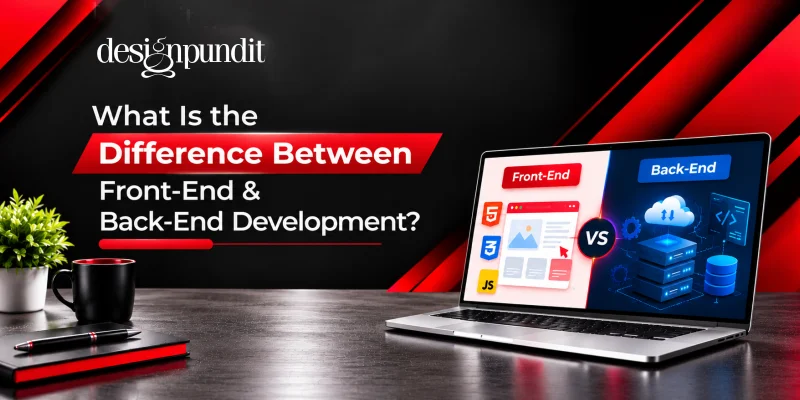
What Is the Difference Between Front-End and Back-End Development?
A website may look simple from the outside but a lot happens behind the screen. Some parts control what users see, while others handle data, logic and how the site works in the background. This is where understanding front end vs back end development becomes useful.
When people talk about web development types they usually mean the different areas involved in building and running a website. Front end and back end development are two of the main parts and both are needed for a smooth user experience.
What Is Front End Development?
Front end development is everything users can see and interact with on a website.
This includes the layout buttons, menus, images, forms, colours and how pages respond when someone clicks or scrolls.
In the front end vs back end development comparison, front end work is the visible side. It focuses on making the website easy to use and pleasant to look at.
Among the main web development types, front end work deals closely with design and user experience.
What Is Back End Development?
Back end development works behind the scenes.
It handles the server, database, user accounts, saved information, login systems, payments and the rules that make the website function.
So, in front end vs back end development the back end is the part users usually do not see.
Among web development types, this area is important because it helps the website process information and respond correctly when users take action.
Just Take An Example To Understand
Think about an online shopping website.
The product page, photos, filters and “Add to Cart” button are part of the front end. When you click the button the back end records the product, updates the cart and may check stock in the database.
This simple example makes front end vs back end development easier to understand.
Different web development types work together in the background to make a website feel smooth and easy.
Front End Focuses on the User Experience
A good website should be easy to understand.
Visitors should know where to click, how to move between pages and what to do next. Front end developers help make that happen.
They work on page structure, mobile responsiveness, loading behaviour, animations, forms and other visible parts.
When comparing front end vs back end development, front end work is usually more closely connected with what the visitor actually experiences.
The aim is simple. A user should be able to visit the website and find what they need without getting confused.
Back End Focuses on How Things Work
The back end is more about logic.
For example, if a user fills out a contact form the back end may save that information and send it to the right place. If someone logs into an account, it checks whether the details are correct.
This is why web development types are not only about appearance. A site can look great but still fail if the back end is weak.
Good back end work helps make the website reliable and functional.
What Tools Are Used?
Front end developers often work with HTML, CSS and JavaScript. These are used to create the structure, style and interactive parts of a webpage.
Back end developers may work with technologies such as PHP, Python, Java, Node.js and database systems such as MySQL or PostgreSQL.
The exact tools depend on the project.
In the front end vs back end development discussion the main point is not which tool is better. Each tool has a different job and helps build a different part of the website.
How Do Front End and Back End Work Together?
They need each other.
Imagine a login page. The front end shows the fields where a person enters an email and password. The back end checks those details and decides whether access should be allowed.
This teamwork is at the heart of front end vs back end development.
It also shows why understanding web development types matters when planning a new website. A strong front end without a good back end can create problems and the opposite is also true.
What About Full Stack Development?
You may also hear the term “full stack developer.”
A full stack developer works across both front end and back end tasks. This does not mean they use every technology available. It simply means they can work on both the visible and hidden sides of a website.
Among different web development types, full stack development can be useful when a project needs someone who understands how both sides connect.
It can also make communication easier when changes on one side affect the other.
Which One Is More Important?
Neither.
That is the simple answer.
In front end vs back end development, both sides have different jobs. The front end shapes the user experience, while the back end makes sure the website actually works.
A beautiful site with broken forms is a problem. A powerful back end with confusing pages is also a problem.
The best websites bring both sides together so that good design and strong functionality work as one.
How Does This Matter for a Business Website?
A business website needs more than good looks.
It should work properly on mobile, load smoothly, collect enquiries, protect information and help visitors understand what the business offers.
That is why choosing the right web development types depends on what the business actually needs.
A small informational website may have simple requirements. An e commerce website, booking platform, customer portal or membership site may need much more back end work.
Thinking about these needs early can save a lot of confusion later.
Can Front End and Back End Affect Website Performance?
Yes.
Poorly built pages can load slowly or feel difficult to use. At the same time, a weak back end may struggle when many users visit the website or request information.
This is another reason both sides need proper planning.
A website should not only look good on launch day. It should continue working well as the business grows, new pages are added and more visitors start using it.
Conclusion
Understanding front end vs back end development makes website planning much easier. The front end is what visitors see and use, while the back end handles data, logic and important website functions.
Knowing the main web development types also helps businesses understand what kind of technology and development support their project may require.
If your business and companies are looking for web design services for small business, Design Pundit can support website projects with clear design, practical development and digital solutions created around real business goals.